
Animation workshop at school: a guide to hiring
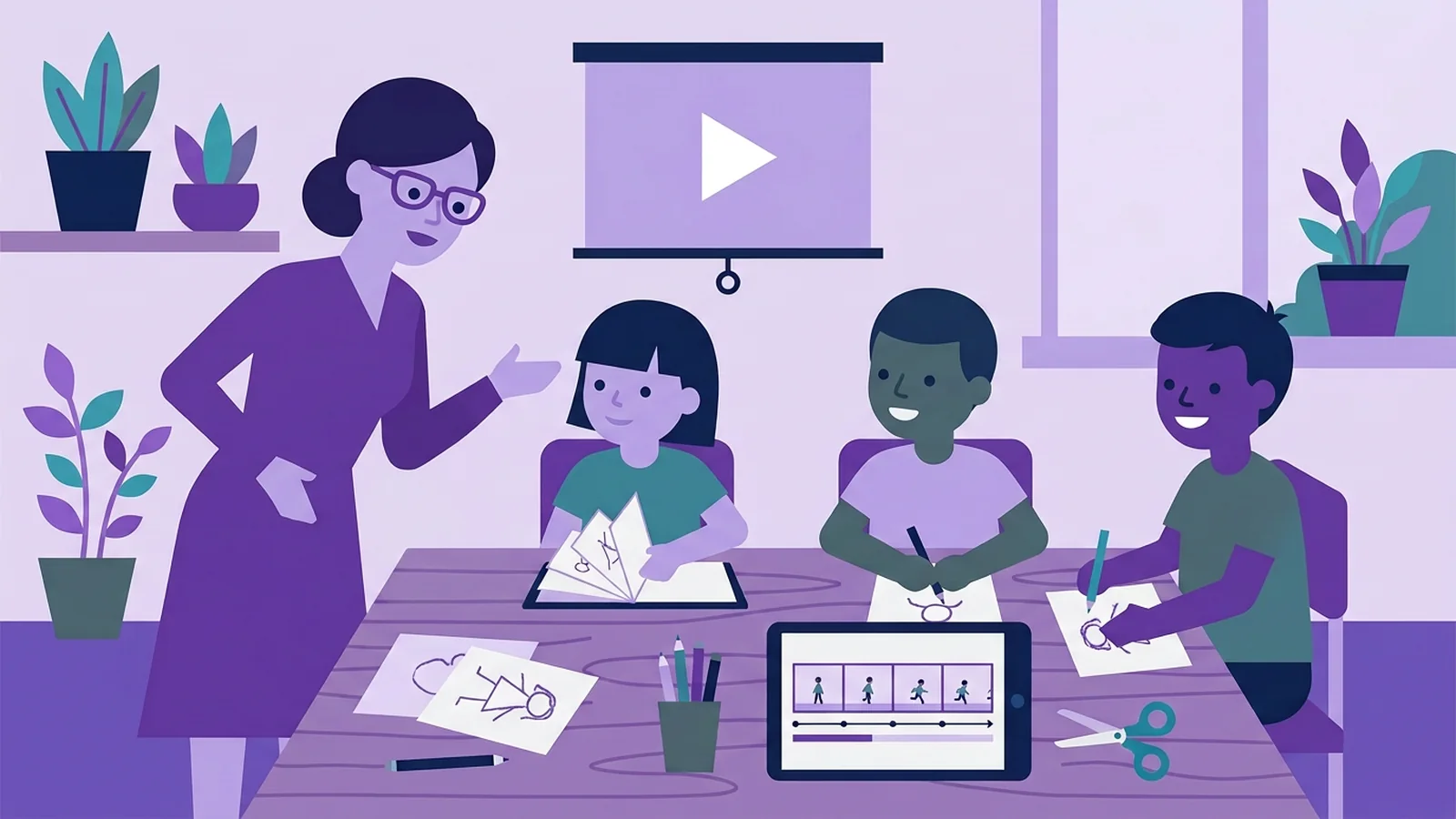
Every school wants an animation workshop. Few know what actually fits in an afternoon — and that is where hiring goes wrong: the institution expects a five-minute short, the instructor delivers a 10-second exercise, and nobody is happy.
This guide is for coordinators: what fits in each workload, what to require from the proposal and how to tell whether the workshop worked.
What fits in 4, 8, 16 hours and 10 sessions
The right question is not “how many hours”, it is “what can the student finish”. The workload defines the size of the final project — and the final project is what the institution will show.
| Format | What really fits | Final project |
|---|---|---|
| 4 hours | Idea, short storyboard, basic principles of movement and a sequence of a few seconds | An animated exercise, on paper or on a phone |
| 8 hours | The same path with time to redo and finish | A 15 to 30-second short, with simple sound |
| 16 hours | Character, background, animation and finishing across four meetings | A 30 to 60-second short, with credits |
| 10 sessions | A full project: research, script, production and presentation | A short film or a series of sketches, shown to the school |
If the institution wants a multi-minute film with a large class, the format is not a workshop: it is a medium-term project. Promising that in four hours is the fastest route to disappointment.
The final project is the contract
Before closing, agree on the deliverable. “Learning animation” is not a deliverable; “each group leaves with a 20-second film” is.
Three questions settle the conversation:
- How many final projects will be delivered? One per student, one per group, or one for the whole class?
- In what format? MP4, GIF, the software’s open file?
- Who keeps the files? The school must be able to screen and store the material afterwards.
The tool the student has
A good workshop does not depend on a computer lab. You can animate on a phone, on simple computers and with free software — and that matters for two reasons: the school does not need expensive equipment, and the student can keep going at home.
Worth asking in the proposal:
- is the software free and does it run on the school’s equipment?
- can the student install the same tool at home?
- does the support material teach the path or just list commands?
A tool the person cannot have teaches nothing. That is why the workshop starts with the project, not the program.
What to require from the proposal
A workshop proposal should answer this in writing:
- Workload and number of meetings — and what fits in each one.
- Final project — a description of what students deliver.
- Maximum number of participants — digital creation classes need individual attention.
- Equipment needed — what the school must provide.
- Support material — what stays with the participants.
- Certificate — workload and content.
- Teacher training — whether the school’s team will learn to repeat the workshop.
- Image authorization — how photos of students will be used.
- Travel and logistics — who brings equipment, who sets up the room.
- Evaluation criteria — how to know whether it worked.
If the proposal does not answer these points, it is still a quote, not a project.
Three common mistakes
1. Classes that are too large. Animation requires following mistake by mistake. With 40 students and one instructor, the workshop becomes a lecture.
2. Starting with the software. Teaching menus and buttons before there is a story to tell produces a technical exercise, not a film. Technique arrives when the project asks for it.
3. Promising a festival. Screening the class’s work at school is great. Promising festival selection is another matter, and it does not depend on the workshop.
How to evaluate whether the workshop worked
The beautiful film is the least important part. What measures the result is what the student can do alone afterwards:
- can they start a new project without the teacher?
- do they understand why one movement works and another does not?
- can they explain the choices in their own film?
- did they ask to continue?
A workshop that ends with that autonomy was worth it. One that ends with a beautiful file and no understanding was just entertainment.
Frequently asked questions
Can you do animation in one afternoon?
Yes, with a small scope: a short sequence, an exercise with a beginning and an end. What does not fit in four hours is a long film with a large class.
Do you need a computer lab?
Not necessarily. Many workshops run on phones or simple computers with free software. The diagnosis defines what the school needs.
What is the minimum age?
Children from 8 or 9 years old can already animate frame by frame with support. From high school onwards, the project can include script and sound in more depth.
Does the workshop train teachers?
It can. The format with teacher training includes a stage where the school’s team learns the method and the material to repeat the workshop the following year.
How much does it cost?
It depends on the format, travel and number of classes. The site has a starting reference and a form to request a proposal — we reply within one business day.
Want to bring a workshop to your school?
Innovate designs the project with you: format, final project, material and teacher training. See the offers for institutions, the training formats or the cultural institution case that started this method.
If you already have an idea, tell us the challenge — we come back with scope, schedule and investment.
Ready to produce your next content with us?
Contact us